
replay
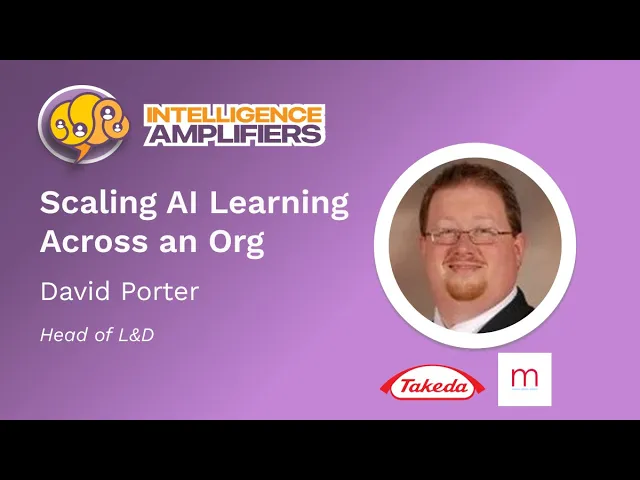
Scaling AI Learning Across an Organization
About the speaker(s)

speaker
David Porter is a Learning & Development leader known for building high-impact learning ecosystems that blend curiosity, culture, and cutting-edge technology. With more than 20 years of experience across tech, biotech, and global enterprises, David has led teams in instructional design, digital learning, leadership development, and AI-driven capability building.
At the time of this recording, David was helping shape AI learning strategy at Moderna, where he played a key role in designing the AI Academy and enabling organization-wide adoption of generative AI. He has since begun a new chapter at Takeda, continuing his work at the intersection of learning, transformation, and human-centered innovation.
Passionate about lifelong learning, neuroscience-backed design, and democratizing access to AI, David’s mission is to unlock curiosity in every employee—and help organizations reimagine what their people can achieve when technology becomes an amplifier, not a barrier.
Scaling AI Learning Across an Organization: Insights from L&D Leader David Porter
TL;DR:
Scaling AI learning isn’t about deploying a chatbot or assigning an “Intro to AI” course. It requires reshaping how people think, work, and experiment with AI at every level of the organization. In this interview with David Porter—now Head of Learning and Development at Takeda—we explore how he built an AI learning ecosystem in a global, highly regulated environment, drove full adoption of generative AI capabilities, and enabled thousands of employees to create real, workflow-embedded AI solutions. The lesson for L&D leaders: meaningful AI learning starts with mindset, expands through application, and scales through curiosity.
Why Scaling AI Learning Is More Than Teaching AI Concepts
Across industries, executives are setting bold expectations for AI adoption. But many organizations fall into the same pattern:
Purchase an AI tool
Offer a high-level course
Publish a policy
Assume transformation will follow
The problem: employees learn about AI, but they don’t learn with AI.
David Porter has seen this challenge first-hand throughout his L&D career across technology and biotech sectors. Early corporate AI training efforts often delivered good content—but little behavior change.
Employees left sessions saying:
“I enjoyed the course… but what should I actually do differently on Monday”
That gap—between knowledge and real work—is where most AI programs stall.
Scaling AI learning requires a shift from education to enablement.
A Strategic Framework for Scaling AI Learning
In our conversation, David outlined a repeatable approach that L&D teams can adapt, regardless of industry. While his past work included time in biotech, these insights now inform his leadership at Takeda and offer a roadmap for any organization seeking to operationalize AI at scale.
1. Ground AI Learning in the Organization’s Reality
Instead of framing AI in abstract “tech” terms, David encourages teams to re-anchor AI around questions employees can answer:
What does AI mean for my function
Which workflows produce the most manual effort
Where do risks, bottlenecks, or rework show up
Which tasks could be automated, accelerated, or reimagined
This reframing moves employees from “AI is for specialists” to “AI is for the work I touch daily.”
2. Design Learning That Produces Use Cases—not Awareness
David’s philosophy is simple: If AI learning doesn’t change someone’s workflow, it didn’t stick.
Effective AI learning includes:
Examples from internal processes
Workflow mapping to spot opportunities
Practical exercises using real tools
Space to prototype early ideas
One concept he uses frequently is identifying AI “superpowers”—a concise set of capabilities that AI handles exceptionally well. This gives employees a mental toolkit to match AI strengths to their own tasks.
3. Democratize AI Through Generative Tools
Generative AI unlocked a turning point for David’s work. Suddenly, non-technical employees could use natural language to:
Build their own assistants
Prototype workflow changes
Automate tedious tasks
Strengthen writing, analysis, and decision-making
Democratization is only real when everyone—not just data teams—can use AI safely and meaningfully.
The result of this approach in David’s prior work was exceptional: thousands of AI assistants, workflows, and GPT-style tools built by everyday employees, not AI experts.
This is the real signal of scaled AI learning:
people building AI tools that reflect their own work.
Inside an AI Learning Ecosystem That Scales
Scaling AI learning across 5,000+ people requires more than a course. David described four components that consistently make the difference.
1. Universal Foundations
Every employee needs shared literacy around:
How AI works (in clear, human language)
How it is used inside the organization
What the guardrails are
What “good” looks like
This creates a baseline for transformation.
2. A Distributed Network of AI Champions
Champions in each function amplify, localize, and contextualize AI learning.
David defines localization as more than translation—it is adaptation:
Manufacturing learns from manufacturing stories
HR learns from HR scenarios
Clinical, R&D, and Commercial teams see their own workflows reflected
People take action when the examples feel like their work, not someone else’s.
3. Layered Learning Experiences
David’s model blends:
Live AI workshops for shared practice
Micro-learning “knowledge nuggets” for quick skills
Workflow-specific guides
Peer conversations and showcases
Together, these experiences keep AI learning active and social, not siloed.
4. Metrics That Measure Behavior, Not Attendance
David emphasizes that L&D must move beyond:
Completions
Hours of training
Meaningful AI scaling requires metrics like:
Daily active use
Number of AI-powered workflows
Quality and adoption of custom assistants
Documented improvements in speed, cost, or compliance
This aligns AI learning to business value—not content delivery.
The Mindset of an AI-Augmented Employee
Beyond tools and training, mindset is the real multiplier.
David describes an AI-augmented employee as:
A person at the center, supported by multiple AI teammates.
This means encouraging employees to think of AI through different “colleagues,” such as:
An expert advisor
A research assistant
A creative partner
A data analyst
A project manager
Once employees adopt this frame, their questions (and their use of AI) improve dramatically.
From Prompting → Context → Purpose
David encourages teams to work across three levels:
Prompt Strategy
Clear instructions and goals.Context Engineering
Sharing background the way you would with a human collaborator.Purpose Engineering
Redesigning work from first principles:
“If this job were invented today in a world with AI, how would we design it”
Purpose engineering is where transformation happens.
Curiosity as a Leadership Skill
David’s advice to his younger self—and to anyone scaling AI learning—is simple:
Never stop being curious.
Curiosity drives experimentation, and experimentation drives transformation.
This mindset is now central to his leadership philosophy at Takeda.
Five Takeaways for L&D Leaders Scaling AI Learning
Make AI learning role-relevant, not abstract.
Anchor everything in real work.Treat AI as a set of teammates, not a single tool.
Encourage employees to use different AI personas.Give everyone hands-on access to safe AI environments.
AI learning only sticks when people build with it.Shift your metrics from learning consumption to workflow change.
Track what teams create, not what they complete.Build a culture where curiosity is rewarded.
Curiosity fuels experimentation—a prerequisite for scaling AI.
Scaling AI learning is one of the most critical L&D challenges of the decade. Leaders like David Porter are showing a path forward: grounded in curiosity, powered by generative tools, and focused on real work, not theoretical understanding.
This is how organizations move from AI-aware to AI-enabled—and eventually, AI-augmented.
If you found David Porter’s perspective helpful and want more real world stories about human centered learning, leadership, and knowledge sharing, check out more episodes of the Intelligence Amplifiers podcast with other industry leaders. Each conversation offers practical, hard won insights you can bring back to your own learning strategy and culture.