
The honest version
You don’t have to choose. Confluence is a genuinely good library, and most of our customers keep it. But a place to store pages is not a place where people learn. This page is honest about where the library ends — and where the school begins.
Who it was built for
Who Confluence was built for
If the job is writing things down and finding them later, Confluence has earned its place. Naming that plainly is the point — because storing knowledge isn’t the same as spreading it.
01
Real-time document collaboration
Co-editing without conflicts is a genuine strength — reviewers cite exceptional team collaboration across hundreds of reviews.
02
A single home for team docs
Meeting notes, project plans, PRDs, runbooks — one place, with a deep template library and version history.
03
Atlassian-suite shops
If your teams live in Jira, the integration is unmatched. Confluence is bought bundled and adopted by default.
04
Reference material at rest
Storing onboarding references and runbooks works well — as long as nobody needs to know whether anyone read them.
The turn
Where the library runs out
Confluence’s own reviewers say it plainly: pages get written once and decay, the real answers stay in Slack and experts’ heads, and nothing tracks whether anyone learned a thing.
01
The wiki graveyard
The most repeated complaint on record: content goes stale silently. “It’s where content goes to die” — there’s no native content lifecycle, so pages decay until people stop trusting them.
02
Tribal knowledge stays tribal
The real answers live in Slack threads and senior engineers’ heads. The wiki holds the formally intended process — not what people actually do.
03
No way to know if anyone learned
No completion, no assessments, no cohorts, no behavior measurement. Confluence can prove a page exists — not that a single person read it, understood it, or changed how they work.
04
Learning programs need scaffolding
Course sequencing, learning paths, cohorts, live-session scheduling: all absent, or third-party add-ons that admit the platform isn’t built for it.
The market, mapped
Same market. Different job.
Plot the tools by what they actually move. Confluence stores explicit knowledge — whatever people manage to write down. PlusPlus sits where tacit expertise meets complex knowledge work: the things your experts can teach but rarely document.
The different category
A school on top of your library
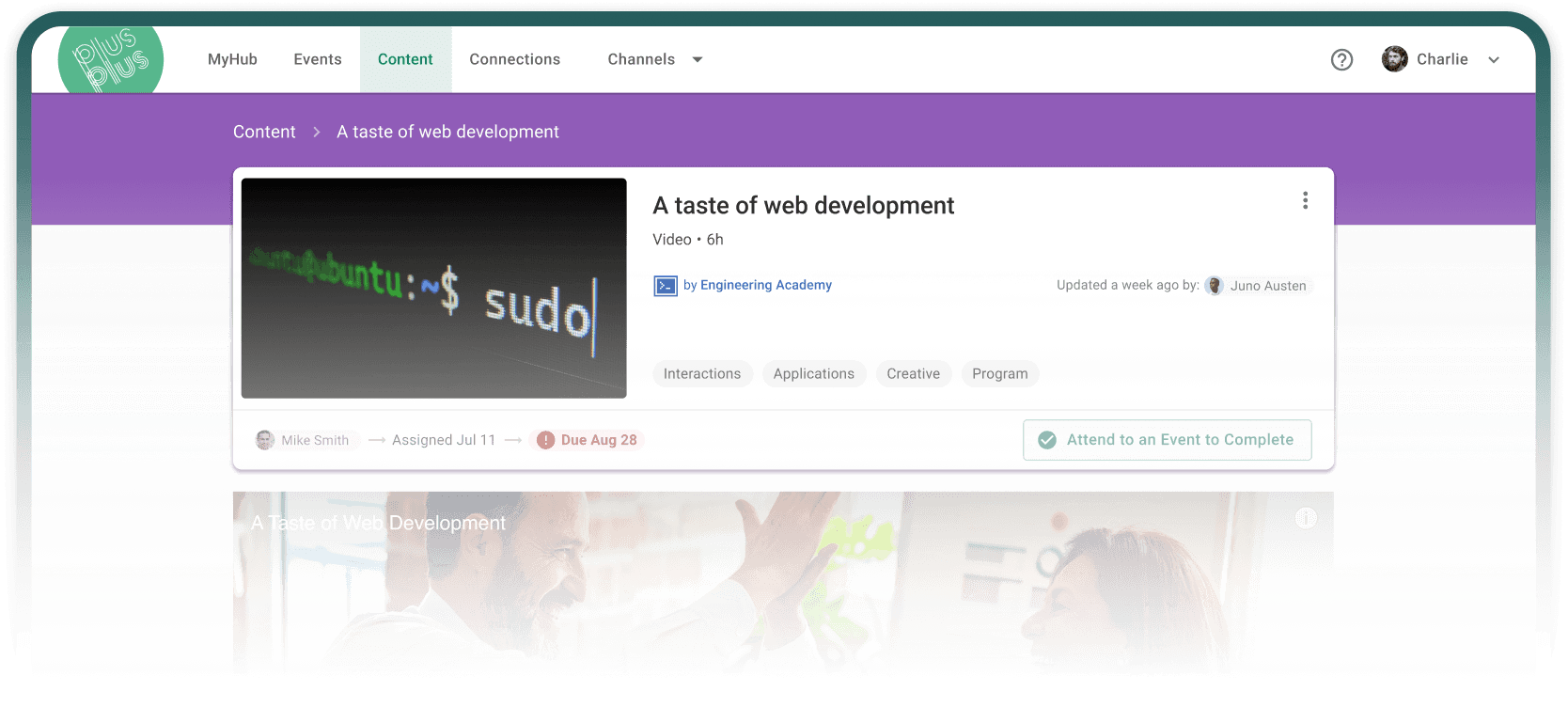
Keep Confluence for what it’s good at. PlusPlus turns your experts into structured programs — onboarding paths, bootcamps, TechTalks, mentorship — with cohorts, completion, and comprehension checks. Talking is native for experts; writing is a tax. So knowledge gets captured as a byproduct of teaching, not a documentation chore.
What PlusPlus customers see
Where we’re different
Four things a wiki can’t be
→ 01
Taught, not written
Experts show up and explain what they know — no context-switching into documentation mode. Capture happens as a side effect of the program running.
→ 02
Self-refreshing by design
A recurring session gets re-recorded every time it’s taught, because someone is teaching it live anyway. The refresh is built into the program, not a maintenance task someone has to remember.
→ 03
Comprehension, validated
A page proves someone wrote something down. A cohort checkpointed against a session proves people understood it — which is also what makes the knowledge trustworthy for your AI.
→ 04
Service that owns the outcome
A named partner designs, launches, and lands the program with you — not a support model where response time scales with license spend.
This week’s new hires are discovering and passing around links to useful PlusPlus resources created by their own peers. It’s rewarding to see!
B
Benji Shine
Slack